Now that we have a scheduler, we can run multiple threads at the same time. This introduces a new problem though: shared resources and synchronization.
Imagine we have a shared resource that can be accessed at a specific address. This resource could be anything from MMIO, a buffer or some variable, the important part is that multiple threads can access it at the same time.
For our example we’re going to say this resource is a NS16550 uart at
address 0xDEAD'BEEF. If not familiar with this type of uart
device, it’s the de facto standard for serial devices. The COM ports on
x86 use one of these, as do many other platforms.
The key things to know are that if we write a byte at that address,
it will be sent over the serial port to whatever is on the other end. So
if to send a message, we must send it one character at a time, at the
address specified (0xDEADBEEF).
Let’s say we use this serial port to for log messages, with a function like the following:
void serial_log(const char* msg) {
    volatile char* resource = (char*)0xDEADBEEF;
    for (size_t i = 0; msg[i] != 0; i++)
        *resource = msg[i];
}
Note that in reality we should check that the uart is ready to receive the next byte, and there is some setup to be done before sending. It will need a little more code than this for a complete uart driver, but that’s outside the scope of this chapter.
Now let’s say we have a thread that wants to log a message:
void thead_one() {
    serial_log("I am the first string");
}
This would work as expected. We would see
I am the first string on the serial output.
Now lets introduce a second thread, that does something similar:
void thead_two() {
    serial_log("while I am the second string");
}
What would we expect to see on the serial output? We don’t know! It’s essentially non-deterministic, since we can’t know how these will be scheduled. Each thread may get to write the full string before the other is scheduled, but more likely they will get in the way of each other.
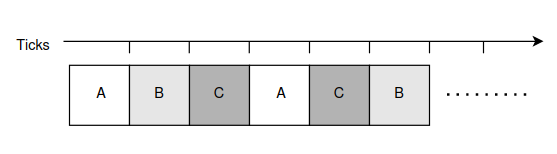
The image above is an example of threads being scheduled, assuming
there are only three of them in the system (labeled as A, B,
C). Imagine that A is thread_one and B is
thread_two, while C does not interact with the serial. One
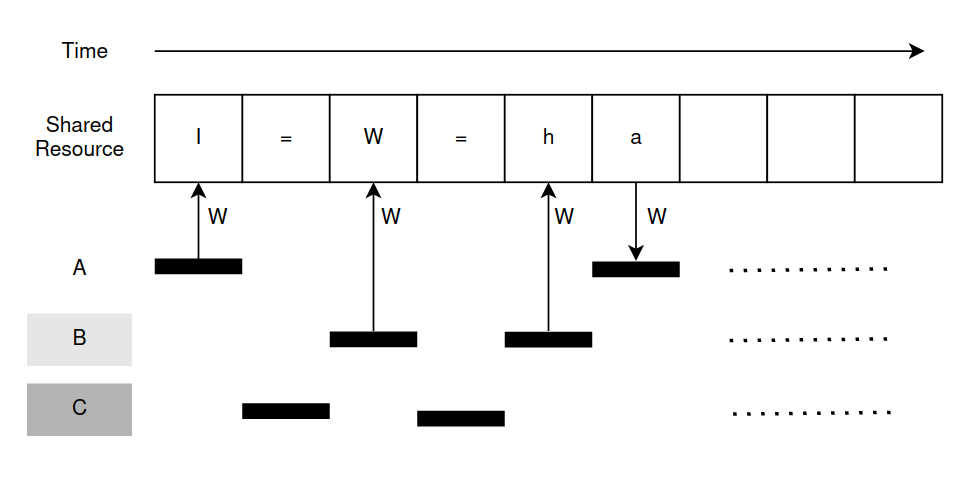
example of what we could see then is
Iwh aI ammi lethe secfionrsd t stristngring. This contains
all the right characters but it’s completely unreadable. The image below
shows what a scenario that could happen:
What we’d expect to see is one of two outcomes:
I am the first string while I am the second or
while I am the second I am the first string.
The situation described is an example of a race condition. The order of accesses to the shared resource (the uart) matters here, so we need a way to protect it. This where a lock comes in.
A lock provides us with something called mutual exclusion: only one thread can hold the lock at a time, while the rest must wait for it to be free again before they can take it. While a thread is holding the lock, it’s allowed to access the shared resource.
We’ll need a few things to achieve that:
acquire (taking the lock) and
release (freeing the lock).While we only need one variable per lock, we’re going to create a new struct for it so it can be expanded in the future.
typedef struct {
    bool lock;
} spinlock_t;

void acquire(spinlock_t* lock);
void release(spinlock_t* lock);
We’ll look at how to implement these functions shortly, but let’s quickly look at how a lock would be used:
spinlock_t serial_lock;

void serial_log(const char* msg) {
    acquire(&serial_lock);

    volatile char* resource = (char*)0xDEADBEEF;
    for (size_t i = 0; msg[i] != 0; i++)
        *resource = msg[i];

    release(&serial_lock);
}
It’s a small change, but it’s very important! Now anytime a thread
tries to call serial_log, the acquire function
will block (wait) until the lock is free, before trying to print to the
serial output.
This ensures that each call to serial_log completes
before another is allowed to start, meaning each message is written
properly without being jumbled by another.
It’s worth noting that each instance of a lock is independent, so to protect a single resource, we must use a single lock.
Let’s look at how acquire and release
should function:
acquire will wait until the lock is free, and then take
it. This prevents a thread from going any further than this function
until it has the lock.release is much simpler, it simply frees the lock. This
indicates to other threads that they can now take the lock.We’ve used a boolean to represent the lock, and are going to use
true for locked/taken, and false for
free/unlocked. Let’s have look at a naive implementation for these
functions:
void acquire(spinlock_t* lock) {
    while (true) {
        if (lock->locked == false) {
            lock->locked = true;
            return;
        }
    }
}

void release(spinlock_t* lock) {
    lock->locked = false;
}
What we’ve implemented here is a spinlock. To take the
lock we keep checking the lock variable within a loop (aka ‘spinning’)
until it’s available. A spinlock is the simplest kind of lock to
implement, and very low latency compared to some others. It can be very
wasteful when it comes to CPU time however, as the CPU is constantly
querying memory only to do nothing but query it again, instead of doing
actual work.
Consider the previous example of threads being sequenced, and let’s see what happens now:
serial_log which calls the
acquire function, so the lock is taken.serial_log, which again calls acquire, but
this time the lock is already taken. So B will do nothing but check the
state of the lock.acquire function waiting for the lock to be freed, so it
will continue to wait. Thread B will spin until it’s preempted
again.acquire will
take the lock and return, and then write thread B’s message to the
uart.Now we can see how locks can be used to keep two threads from interfering with each other.
Unfortunately this implementation has some issues, and can fail to ensure mutual exclusion in several ways:
volatile, so the
acquire and release operations may or may not be written to memory. This
means other threads might not even see the changes made to the lock
variable.volatile, two threads on separate
processors could still both take the lock at the same time. This is
because processors will generally perform a
read-modify-write operation, which leaves time for another
processor to read the old state, while another is modifying it.Let’s talk about atomic operations. An atomic operation is
something the CPU does that cannot be interrupted by anything (including
other processors). The relevant cpu manuals can provide more information
how this is implemented (for x86, look for information on the
LOCK opcode prefix). For now, all we need to know is that
it works.
Rather than writing assembly directly for this, we’re going to use some compiler intrinsic functions to generate the assembly for us. These are provided by any compatible GCC compiler (that includes clang).
We’re going to use the following two functions:
bool __atomic_test_and_set(void* ptr, int memorder);
void __atomic_release(void* ptr, int memorder);
We’ll also be using two constants (these are provided by the compiler
as well): __ATOMIC_ACQUIRE and
__ATOMIC_RELEASE. These are memory order constraints and
are used to describe to the compiler what we want to accomplish. Let’s
look at the difference between these, and a third constraint, sequential
consistency (__ATOMIC_SEQ_CST).
__ATOMIC_SEQ_CST: An atomic operation with this
constraint is a two-way barrier. Memory operations (reads and writes)
that happen before this operation must complete before it, and
operations that happen after it must also complete after it. This is
actually what we expect to happen most of the time, and if not sure
which constraint to use, this is an excellent default. However it’s also
the most restrictive, and implies the biggest performance penalty as a
result.__ATOMIC_ACQUIRE: Less restrictive, it communicates
that operations after this point in the code cannot be reordered to
happen before it. It allows the reverse though (writes that happened
before this may complete after it).__ATOMIC_RELEASE: This is the reverse of acquire, this
constraint says that any memory operations before this must complete
before this point in the code. Operations after this point may be
reordered before this point however.Using these constraints we can be specific enough to achieve what we
want while leaving room for the compiler and cpu to optimize for us. We
won’t use it here, but there is another ordering constraint to be aware
of: __ATOMIC_RELAXED. Relaxed ordering is useful when in
case a memory operation is desired to be atomic, but not interact with
the memory operations surrounding it.
Both of the previously mentioned atomic functions take a pointer to
either a bool or char that’s used as the lock
variable, and the memory order. The __atomic_test_and_set
function returns the previous state of the lock. So if it
returns true, the lock was already taken. A return of falses indicates
we successfully took the lock.
Using our new compiler intrinsics, we can update the
acquire and release functions to look like the
following:
void acquire(spinlock_t* lock) {
    while (__atomic_test_and_set(&lock->locked, __ATOMIC_ACQUIRE));
}

void release(spinlock_t* lock) {
    __atomic_release(&lock->locked, __ATOMIC_RELEASE);
}
Using the compiler built-in functions like this ensures that the compiler will always generate the correct atomic instructions for us. These are also cross-platform: meaning if the kernel is ported to another cpu architecture, it can still use these functions.
While atomic operations are fantastic, they are often quite slow compared to their non-atomic counterparts. Of course it’s impossible to implement a proper lock without atomics so we must use them, however it’s equally important not to over use them.
With the introduction of locks we’ve also introduced a new problem. Using the previous example of the shared uart, used for logging, let’s see what might happen:
There is no decisive solution to this, and instead care must be taken when using locks within the kernel. One option is to simply disable interrupts when taking a lock that might also be taken inside an interrupt handler. Another option is to have alternate code paths for things when inside of an interrupt handler.
In this chapter we’ve implemented a simple spinlock that allows us to protect shared resources. Obviously there are other types of locks that could be implemented, each with various pros and cons. For example the spinlock shown here has the following problems:
Preventing a deadlock is big topic that can be condensed to be: be careful what locks are held when taking another lock. Best practice is to never hold more than a single lock if it can be avoided.
There are also more complex types of locks like semaphores and mutexes. A semaphore is a different kind of lock, as it’s usually provided by the kernel to other programs. This makes the semaphore quite expensive to use, as every lock/unlock requires a system call, but it allows the kernel to make decisions when a program wants to acquire/release the semaphore. For example if a thread tries to acquire a semaphore that is taken, the kernel might put the current thread to sleep and reschedule. When another thread releases the semaphore, the kernel will wake up the sleeping thread and have it scheduled next. Semaphores can also allow for more than one thread to hold the lock at a time.