Welcome to the last layer of memory allocation, the heap, this is where usually the various alloc functions are implemented. This layer is usually built on top of the other layers of memory management (PMM and VMM), but a heap can be built on top of anything, even another heap! Since different implementations have different characteristics, they may be favoured for certain things. We will describe a way of building a heap allocator that is easy to understand, piece by piece. The final form will be a linked list.
We’ll focus on three things: allocating memory
(alloc()), freeing memory (free()) and the
data structure needed for those to work.
The term ‘heap’ has a few meanings, and if coming from a computer science course the first thought might be the data structure (specialized tree). That can be used to implement a heap allocator (hence the name), but it’s not what we’re talking about here.
This term when used in a memory management/osdev environment has a
different meaning, and it usually refers to the code where memory is
dynamically allocated (malloc() and friends).
There are many kinds of memory allocators in the osdev world (physical, virtual, and others) with various subtypes (page frame, bitmap, etc …). For the next section we assume the following components are present:
If some of these terms need more explanation, they have chapters of their own to explain their purpose and function!
With the above assumptions, what happens under the hood when we want to allocate some memory from the heap?
As with other OS components there are many different algorithms out there for managing memory, each with its pros and cons. Here we’ll explain a simple and efficient algorithm based on linked lists. Another common algorithm used for a heap is the slab allocator. This is a very fast, but potentially more wasteful algorithm. This is not covered here and exploring slab allocators is left as an exercise for the reader.
A heap allocator exposes two main functions:
void *alloc(size_t size); To request memory of size
bytes.void free(void *ptr); To free previously allocated
memory.In user space these are the well known malloc()/free()
functions. However, the kernel will also need its own heap (we don’t
want to put data where user programs can access it!). The kernel heap
usually exposes functions called kmalloc()/kfree().
Functionally these heaps can be the same.
So let’s get started with describing the allocation algorithm.
Authors note: In the following examples we will use
uint8_t for all the pointers, but in a real scenario it
will be better to use a bigger size for the variable keeping track of
the allocated region sizes (so we’re not limited to 255 bytes).
The easiest way to start with creating our allocator is to ask: “What does a heap allocator do?”.
Well the answer is, as we already know: it allocates memory, specifically in bytes. The bytes part is important, because as kernel developers we’re probably used to dealing with pages and page-sized things. If the program asks for X bytes, the allocator will return an address pointing to an area of memory that is at least X bytes. The VMM is allocating memory, but the biggest difference is that the Heap is allocating bytes, while the VMM is allocating Pages.
If we are writing an OS, we already know that RAM can be viewed as a very long array, where the index into this array is the memory address. The allocator is returning these indices. So we can already see the first detail we’ll need to keep track of: next available address.
Let’s start with a simple example, assume that we have an address
space of 100 bytes, nothing has been allocated yet, and the program
makes the following consecutive alloc() calls:
alloc(10);
alloc(3);
alloc(5);
Initially our ram looks like the following:
| 0000 | 0001 | 0002 | … | 0099 | 00100 |
|---|---|---|---|---|---|
| cur |
cur is the variable keeping track of the next address
that can be returned and is initialized to 0, in this example. Now when
the alloc(10) is called, the program is asking for a memory
location of 10 bytes. Since cur = 0, the address to return
is 0, and the next available address will become:
cur + 10.
So now we have the following situation:
| 0000 | 0001 | 0002 | … | 0010 | … | 00100 |
|---|---|---|---|---|---|---|
| X | X | X | cur |
X is just used as marker to convey that memory has been
allocated already. Now when calling alloc(3), the allocator
will return the address currently pointed by cur = 10 and
then move cur 3 bytes forward.
| 0000 | 0001 | 0002 | … | 0010 | … | 0013 | … | 00100 |
|---|---|---|---|---|---|---|---|---|
| X | X | X | X | cur |
Now the third alloc() call will work similarly to the
others, and we can imagine the results. `
What we have so far is already an allocation algorithm, that’s easy to implement and very fast!
uint8_t *cur_heap_position = 0; //Just an example, in the real world you would use
                                //a virtual address allocated from the VMM.
void *first_alloc(size_t size) {
  uint8_t *addr_to_return = cur_heap_position;
  cur_heap_position = cur_heap_position + size;
  return (void*) addr_to_return;
}
Congratulations! We have written our first allocator! It is called the bump allocator, because each allocation just bumps the next address pointer forward.
But what about free()? That’s even easier, let’s have a
look at it:
void first_free(void *ptr) {
    return;
}
Yeah… that’s right, it’s not an error. A bump allocator does not have
free().
Why? Because we are not keeping track of the allocated memory, so we
can’t just update the cur_heap_position variable with the
address of ptr, since we don’t know who is using the memory after ptr.
So we are forced just to do nothing.
Even if probably useless let’s see what are the pros and cons of this approach:
Pros:
Of course the cons are probably pretty clear and make this algorithm pretty useless in most cases:
The main problem with the algorithm outlined above is that we don’t keep track of what we have allocated in the past, so we are not able to free that memory in the future, when it’s no longer used.
Now we’re going to build a new allocator based on the one we just implemented. The first thing to do is try to figure out what are the information we need to keep track of from the previous allocations:
x bytes of
memory, so when we return the address, we know that the next free one
will be at least at: returned_address + x so we need to
keep track of the allocation size.Now the problem is: how do we keep track of this information?
For this example let’s keep things extremely simple: place the size
just before the pointer. Whenever we make an allocation we write the
size to the address pointed by cur_heap_position, increment
the pointer and return that address. The updated code should look like
the following:
uint8_t *heap_start = 0;
uint8_t *cur_heap_position = heap_start; //This is just pseudocode in real word this will be a memory location

void *second_alloc(size_t size) {
  *cur_heap_position = size;
  cur_heap_position = cur_heap_position + 1;
  uint8_t *addr_to_return = cur_heap_position;
  cur_heap_position += size;
  return (void*) addr_to_return;
}
This new function potentially fixes one of the problems we listed above: it can now let us traverse the heap because we know that the heap has the following structure:
| 0000 | 0001 | 0002 | 0003 | … | 0010 | 0011 | 0013 | … | 00100 |
|---|---|---|---|---|---|---|---|---|---|
| 2 | X | X | 7 | … | X | cur | … |
Authors note: just a reminder that the pointer is a uint8_t
pointer, so when we are storing the size, the memory cell pointed by
cur_heap_position will be of type uint8_t, that means that in
this example and the followings, the size stored can be maximum 255. In
a real allocator we want to support bigger allocations, so using at
least a uint32_t or even size_t is
recommended.
In this example, the number indicates the size of the allocated block. There have already been 2 memory allocations, with the first of 2 bytes and the second of 7 bytes. Now if we want to iterate from the first to the last item allocated the code will look like:
uint8_t *cur_pointer = start_pointer;
while(cur_pointer < cur_heap_pointer) {
  printf("Allocated address: size: %d - 0x%x\n", *cur_pointer, cur_pointer+1);
  cur_pointer = cur_pointer + (*cur_pointer) + 1;
}
But are we able to reclaim unused memory with this approach? The answer is no. You may think so, but even if we know the size of the area to reclaim, and we can reach it everytime from the start of the heap, there is no mechanism to mark this area as available or not. If we set the size field to 0, we break the heap (all areas after the one we are trying to free will become unreachable).
So to solve this issue we need to keep track of the new information: whether a chunk of memory is used or free.
So now everytime we will make an allocation we will keep track of:
At this point our new heap allocation will look like:
| 0000 | 0001 | 0002 | 0003 | 0004 | … | 0011 | 0011 | 0013 | … | 00100 |
|---|---|---|---|---|---|---|---|---|---|---|
| 2 | U | X | 7 | U | … | X | cur | … |
Where U is just a label for a boolean-like variable (U = used = false, F = true = free).
At this point we the first change we can do to our allocation function is add the new status variable just after the size:
#define USED 1
#define FREE 0

uint8_t *heap_start = 0;
uint8_t *cur_heap_position = heap_start; //This is just pseudocode in real word this will be a memory location

void *third_alloc(size_t size) {
  *cur_heap_position = size;
  cur_heap_position = cur_heap_position + 1;
  *cur_heap_position = USED;
  cur_heap_position = cur_heap_position + 1;
  uint8_t *addr_to_return = cur_heap_position;
  cur_heap_position += size;
  return (void*) addr_to_return;
}
One thing that might have been noticed so far is that in order to
keep track of all those new information, we are adding an overhead to
our allocator. How big this overhead is depends on the size of the
variables we use in the chunk headers (where we store the alloc size and
status). Even if we keep things small by only using
uint8_t, we have already added 2 bytes of overhead for
every single allocation. The implementation above is not completed yet,
since we haven’t implemented a mechanism to re-use the freed location
but before adding this last piece let’s talk about the free.
Now we know that given a pointer ptr (previously
allocated from our heap, of course) ptr - 1 is the status
(and should be USED) and ptr - 2 is the size.
Using this our free can be pretty simple:
void third_free(void *ptr) {
  if( *(ptr - 1) == USED ) {
    *(ptr - 1) = FREE;
  }
}
Yeah, that’s it! We just need to change the status, and the allocator will be able to know whether the memory location is used or not.
Now that we can free, we should add support for returning from this
freed memory. How the new alloc() works is as follows:
cur_pointer is pointing to the first metadata byte of the
location to be returned (the size in our example) the code to update and
return the current block will be pretty simple:cur_pointer = cur_pointer + 1; //remember cur_pointer is pointing to the size byte, and is different from current_heap end
*cur_pointer = USED;
cur_pointer = cur_pointer + 1;
return cur_pointer;There is also no need to update the cur_heap_end, since it has not been touched.
cur_pointer == cur_heap_position:*cur_pointer = size;
cur_pointer = cur_pointer + 1;
*cur_pointer = USED;
cur_pointer = cur_pointer + 1;
cur_heap_position = cur_pointer + size;
return cur_pointer;We have already seen how to traverse the heap when explaining the second version of the alloc function. Now we just need to adjust that example to this newer scenario where we have now two extra bytes with information about the allocation instead of one. The code for alloc will now look like:
#define USED 1
#define FREE 0

uint8_t *heap_start = 0;
uint8_t *cur_heap_position = heap_start; //This is just pseudocode in real word this will be a memory location

void *third_alloc(size_t size) {
  cur_pointer = heap_start;

  while(cur_pointer < cur_heap_position) {
    cur_size = *cur_pointer;
    status = *(cur_pointer + 1);

    if(cur_size >= size && status == FREE) {
       status = USED;
       return cur_pointer + 2;
    }
    cur_pointer = cur_pointer + (size + 2);
  }

  *cur_heap_position=size;
  cur_heap_position = cur_heap_position + 1;
  *cur_heap_position = USED;
  cur_heap_position = cur_heap_position + 1;
  uint8_t *addr_to_return = cur_heap_position;
  cur_heap_position+=size;
  return (void*) addr_to_return;
}
If we are returning a previously allocated address, we don’t need to
move cur_heap_position, since we are reusing an area of
memory that is before the end of the heap.
Now we have a decent and working function that can free previously allocated memory, and is able to reuse it. It is still not perfect and there are several major problems:
Another thing worth doing is to improve readability of the code by replacing the direct pointer access with a more elegant data structure. This lets us add more fields (as we will in the next paragraph) as needed.
So far our allocator needs to keep track of just the size of the block returned and its status The data structure for this could look like the following:
struct {
    size_t size;
    uint8_t status;
} Heap_Node;
That’s it! That’s what we need to clean up the code and replace the pointers in the latest with the new struct reference. Since it is just matter of replacing few variables, implementing this part is left to the reader.
So now we have a basic memory allocator (woo hoo), and we are nearing the end of our memory journey.
In this part we’ll see how to help mitigate the fragmentation problem. It is not a definitive solution, but this lets us reuse memory in a more efficient way. Before proceeding let’s recap what we’ve done so far.
This solution is known with the name Coalescing, and it simply is an algorithm that merge contiguous smaller block of free memory into a bigger one.
We started from a simple pointer to the latest allocated location, and added information in order to keep track of what was previously allocated and how big it was, needed to reuse the freed memory.
We’ve basically created a list of memory regions that we can traverse to find the next/prev region.
Let’s look at fragmentation a little more closely, in the following example. We assume that we have a heap limited to 25 bytes:
a = third_alloc(6);
b = third_alloc(6);
c = third_alloc(6)
free(c);
free(b);
free(a);
What the heap will look like after the code above?
| 00 | 01 | 02 | .. | 07 | 08 | 09 | 10 | .. | 15 | 16 | 17 | .. | 23 | 24 | 25 |
|---|---|---|---|---|---|---|---|---|---|---|---|---|---|---|---|
| 6 | F | X | .. | X | 6 | F | X | .. | X | 6 | F | .. | X |
Now, all of the memory in the heap is available to allocate (except for the overhead used to store the status of each chunk), and everything looks perfectly fine. But the code keeps executing, and it will arrive at the following instruction:
alloc(7);Pretty small allocation, and we have plenty of space… no wait. The heap is mostly empty, but we can’t allocate just 7 bytes because all the free blocks are too small. That is fragmentation in a nutshell.
How do we solve this issue? The idea is pretty straightforward, every time a memory location is being freed, we do the following:
ptr_to_free + ptr_to_free_size == next_node then
merge the two nodes and create a single node of
ptr_to_free_size + next_node_size (notice we don’t need to
add the size of Heap_node because ptr should
be the address immediately after the struct).prev_node_address + prev_node_size + sizeof(Heap_Node) == ptr_to_free
then merge the two nodes and create a single node of
prev_node_size + ptr_to_free_sizeThere are different ways to implement this:
next and prev pointer to the node
structure. This is the way we’ll use in the rest of this chapter. This
makes checking the next and previous nodes for merge-ability very easy.
It does dramatically increase the memory overhead. Checking if a node
can be merged can be done via
(cur_node->prev).status = FREE and
(next_node->next).status = FREE.ptr_to_free, and if is free we can merge. For the next node
instead things are easier: we just need to check if the node starting at
ptr_to_free + ptr_size if it is free is possible to merge.
By comparison this increases the runtime overhead of
free().Both solutions have their own pros and cons, like previously
mentioned we’ll go with the first one for these examples. Adding the
prev and next pointers to the heap node struct
leaves us with:
typedef struct {
    size_t size;
    uint8_t status;
    Heap_Node *prev;
    Heap_Node *next;
} Heap_Node;
So now our heap node will look like the following in memory:
| 00 | 01 | 02 | 10 | 18 |
|---|---|---|---|---|
| 6 | F/U | PREV | NEXT | X |
As mentioned earlier using the double linked list the check for
merge-ability is more straightforward. For example to check if we can
merge with the left node we just need to check the status of the node
pointed by the prev field, if it is free then they can be merged. To
merge with the previous node, we would apply the logic below to
node->prev:
size field, adding to it the size of
cur_nodenext pointer to point to
cur_node->nextReferring to the next node:
prev pointer to point to the previous node
above (cur_node->prev)Of course merging with the right node is the opposite (update the size and the prev pointer of cur_node->next and update the next pointer of cur_node->next).
Important note: We always want to merge in the order
of current + next and then prev + current as
if the prev node absorbs current, what happens to the memory owned by
the next node when merged with it? Nothing, it’s simply lost. It can be
avoided with clever and careful logic, but the simpler solution is to
simply merge in the right order.
Below a pseudocode example of how to merge left:
Heap_Node *prev_node = cur_pointer->prev //cur_pointer is the node we want to check if can be merged
if (prev_node != NULL && prev_node->status == FREE) {
    // The prev node is free, and cur node is going to be freed so we can merge them
    Heap_Node next_node = cur_pointer->next;
    prev_node->size = prev_node->size + cur_node->size + sizeof(Heap_Node);
    prev_node->next = cur_pointer->next;
    if (next_node != NULL) {
        next_node->prev = prev_node;
    }
}
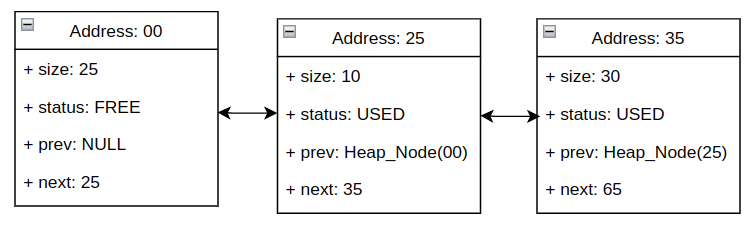
What we’re describing here is the left node being “swallowed” by the right one, and growing in size. The memory that the left node owns and is responsible for is now part of the right one. To make it easier to understand, consider the portion of a hypothetical heap in the picture below:
Basically the heap starts from address 0, the first node is marked as
free and the next two nodes are both used. Now imagine that
free() is called on the second address (for this example we
consider size of the heap node structure to be just of 2 bytes):
free(0x27); //Remember the overheadThis means that the allocator (before marking this location as free and returning) will check if it is possible to merge first to the left (YES) and then to the right (NO since the next node is still in use) and then will proceed with a merge only on the left side. The final result will be:
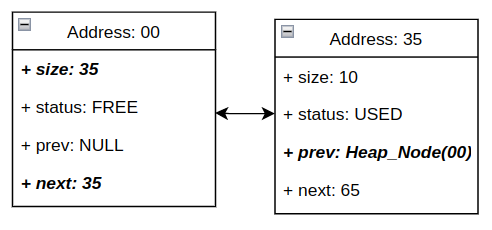
The fields in bold are the fields that are changed. The exact implementation of this code is left to the reader.
Now we have a way to help reduce fragmentation, on to the next major issue: wasted memory from allocating chunks that are too big. In this part we will see how to mitigate this.
Imagine our memory manager is allocating and freeing memory for a while, and we arrive at a moment in time where we have just three nodes:
Now alloc() is called again, like so:
alloc(10);The allocator is going to look for the first node it can return that is at least 10 bytes. Using the example from above, this will be the first node. Everything looks fine, except that we’ve just returned 150 bytes for a 10 byte allocation (i.e. ~140 bytes of memory is wasted). There are a few ways to approach this problem: * The first solution that comes to mind is to scan the entire heap each time and use the smallest (but still big enough for the requested size) node. This is better, but the downside (speed) should be obvious. This will also still not work as well as the second solution because in the above example it would still return 150 bytes. * What we’re going to do is ‘cut’ the space that we need from the node, splitting it into 2 new nodes. The first node will be the request allocation size, and is used to fulfill that. The other will be kept as a free node, inserted into the linked list.
The workflow will be the following:
(uintptr_t)cur_node + requested_bytes. Set this node’s size
to cur_node->size - requested_bytes - sizeof(Heap_Node),
we’re subtracting the size of the Heap_Node struct here because we’re
going to use some memory in the heap to store this new node. This is the
process of inserting into the heap.cut_node->size should now be the requested
size.heap_tail variable should be
updated as well, if it is being used (this depends on design
decisions).After that the allocator can compute the address to return using
(uintptr_t)cur_node + sizeof(Heap_node), since we want to
return the memory after the node, not the node itself
(otherwise the program would put data there and overwrite what we’ve
stored!).
Before wrapping up there’s a few things worth pointing out about implementing splitting:
sizeof(Heap_Node), because otherwise they will never be
allocated.minimum_allocatable_size is
0x20 bytes, and we want to allocate 5 bytes, we will still receive a
memory block of 0x20 bytes. The program may not know it was
returned 0x20 bytes, but that is okay. What exact value
should be used for it is implementation specific, values of
0x10 and 0x20 are popular.sizeof(Heap_Node) bytes while computing sizes that involve
multiple nodes. If we decide to include the overhead size in the node’s
size, remember to also subtract it when checking for suitable
nodes.And that’s it!
Each heap will likely have different requirements for how it’s initialized, depending on whether it’s a heap for a user program, or it’s running as part of a kernel. For a userspace program heap we may want to allocate a bigger initial size if we know the program will need it. As the operating system grows there will be more instances of the heap (usually at least one per program + global kernel heap), and it becomes important to keep track of all the memory used by these heaps. This is often a job that the VMM for a process will take on.
What is really needed to initialize a heap is an initial size (for example 8k), and to create a single starting node:
Heap_Node *heap_start;
Heap_Node *heap_end;
void initialize_heap() {
  heap_start = INITIAL_HEAP_ADDRESS //Remember is a virtual address;
  heap_start->prev = NULL;
  heap_start->next = NULL; // Just make sure that prev and next are not going anywhere
  heap_start->status = FREE;
  heap_start->size = INITIAL_HEAP_SIZE // 8096 = 8k;
  heap_end = heap_start
}
Now the question is, how do we choose the starting address? This really is arbitrary. We can pick any address that we like, but there are a few constraints that we should follow:
For the kernel heap, a good place for it to start is immediately
following the kernel binary in memory. If the kernel is loaded at
0xFFFFFFFF80000000 as is common for higher half kernels,
and the kernel is 0x4321 bytes long. It round up to the
nearest page and then add another page (0x4321 gets rounded
to 0x5000, add 0x1000 now we’re at
0x6000). Therefore, our kernel heap would start at
0xFFFFFFFF80006000.
The reason for the empty page is that it can be left unmapped, and then any buggy code that attempts to access memory before the heap will likely cause a page fault, rather than returning bits of the kernel.
And that’s it, that is how the heap is initialized with a single node. The first allocation will trigger a split from that node… and so on…
One final part that we will be explained briefly, is what happens when we reach the end of the heap. Imagine the following scenario we have done a lot of allocations, most of the heap nodes are used and the few usable nodes are small. The next allocation request will fail to find a suitable node because the requested size is bigger than any free node available. Now the allocator has searched through the heap, and reached the end without success. What happens next? Time to expand the heap by adding more memory to the end of it.
Here is where the virtual memory manager will join the game. Roughly what will happen is:
heap_end + heap_end->size + sizeof(heap_node).And with that we’ve just written a fairly complete heap allocator.
A final note: in these examples we’re not zeroing the memory returned
by the heap, which languages like C++ may expect when new
and delete operators are used. This can lead to
non-deterministic bugs where objects may be initialized with left over
values from previous allocations (if the memory has been used before),
and suddenly default construction is not doing what is expected. Doing a
memset() on each block of memory returned does cost cpu
time, so it’s a trade off, a decision to be made for your specific
implementation.